
Your Navigation :
Origins and Core Assumptions
Emergence of the Great Man Theory
The Great Man theory emerged in the 19th century, most strongly associated with Thomas Carlyle, particularly in his published lectures, On Heroes, Hero-Worship, and the Heroic in History (Carlyle, 1841).
Carlyle argued that leaders are born, not made, and that history is shaped by exceptional individuals who possess innate traits, such as courage, vision, and charisma. This rests on Carlyle’s assumption that society progresses through their actions and decisions.
Carlyle famously argued:
“The history of the world is but the biography of great men.”
This positioned leadership as individual-centric, top-down in its direction, and extraordinary rather than learnable.
Later thinkers like Francis Galton (1822 – 1911) reinforced this through early studies of heredity and genius (Galton being described as the father of eugenics, the study of heredity in human behaviour). Through his work on heredity and his book, Hereditary Genius (Galton, 1869), Galton asserted that leadership, intelligence, and high ability were inherited traits rather than qualities developed through education or environment. Building on Carlyle, this led to the popular approach known as “Trait Leadership”.
Evolution into “Heroic Leadership” as a form of Trait Leadership
Although the language of “Great Man” has faded (not least due to gender bias), the underlying logic persists in what we now call heroic leadership. The key characteristics of heroic leadership include:
- Centralised authority
- The leader as visionary saviour
- Emphasis on decisiveness and control
- Narrative of individual responsibility for success/failure
How does Trait Theory Manifest in Practice?
Despite decades of evolution in leadership theory, the heroic model continues to shape behaviour, structures, and expectations in practice—not solely through individual intent, but through reinforcing systems. Entities’ hierarchies often concentrate authority and expectation at the top, while cultural norms position leaders as the primary source of direction and certainty. This, in turn, creates behavioural pressure on leaders to project confidence and control, often at the expense of inquiry, vulnerability, and shared understanding.
Simultaneously, patterns of followership reinforce and respond to these dynamics. Ownership is diluted, challenge is discouraged, and reliance on authority is internalised as normal. These tendencies reach new heights in times of crisis, where the need for quick action legitimises commands from above and amplifies the myth of the “strong leader.” Performance management systems tend to reinforce this behaviour as well by rewarding success on an individual level while blame is dissipated or displaced within the system. Leadership development often exacerbates the problem by continuing to place individual competence above collective capacity, heroic leadership traits above relational leadership, and specialised expertise above system thinking.
Taken together, these interconnected conditions do not merely support heroic leadership as behaviour; they continuously reproduce it. We will examine six examples in the illustration below to determine the conditions for a trait-dominant leadership culture, highlighting leaders’ trait leadership characteristics and how they manifest in practice.
Traits Sustain the System
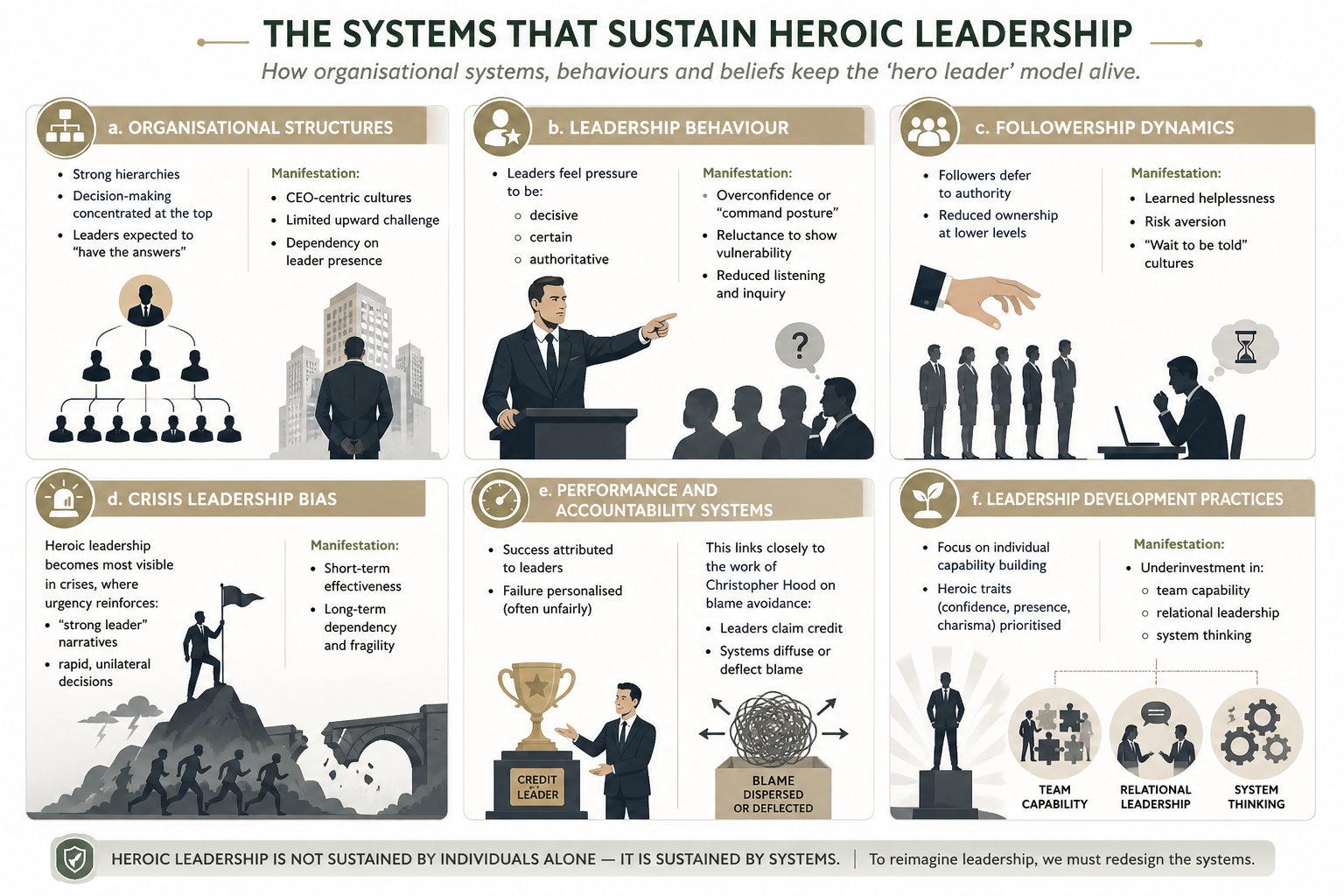
Is it the individual or the system?
What appears as “strong leadership” is often less a function of individual capability and more a predictable outcome of systems designed to centralise control, reward visibility, and distribute responsibility unevenly.
The challenge, therefore, is not simply to develop different leaders, but to redesign the conditions under which leadership is understood, enacted, and sustained.
Why does Trait Theory persist?
The Benefits
We often throw out ideas by taking a biased view that everything about the idea is wrong. Although there is a strong argument against leadership that is too authoritative, with leaders who dictate what needs to happen and how to make it happen, there are also some circumstances and some conditions where such directive leadership is needed. Such circumstances may arise when immediate leadership action is needed. An example is provided below, based on four criteria aligned with the challenges of dealing with a natural disaster.
This example serves us well. Crises do not simply create operational problems; they fundamentally disrupt the meaning of leadership and how we coordinate the pressing challenges whilst maintaining community confidence and institutional legitimacy.
Under these conditions, organisations often regress toward more heroic and centralised forms of leadership. Institutional leadership will be critical, as the institution may involve the leadership of several organisations, each with its own leaders, priorities, and, of course, egos. The key is to retain institutional integrity.
The direction is unclear and needs immediate clarity.
This will often be the case in crisis or emergency situations, where time pressure is extreme. An illustration of this is a natural disaster that affects significant populations. Particularly in the early stages, the information may be sparse, the consequences may not be fully known, and communities and their potential local leaders may be in disarray, though not by their own fault.
Extreme Time Pressure
The “acute crisis stage” (Fink, 2002) reflects compressed decision windows in which delay can be dangerous, consultation feels costly, and rapid judgment becomes necessary. This results in a narrowing of engagement and the normalisation of command-and-control leadership, with the consequences of unilateral action.
Coordination is difficult.
Crises disrupt communication systems, role clarity, and require institutional trust whilst recognising interdependence. As complexity increases, coordination across teams becomes harder. Information fragments which can easily result in organisational risk paralysis. The heroic model seeks to address this through a single voice, an integrated focal point, and a single command-and-control decision point.
Symbolic Leadership
Crises are not only operational events; they are also symbolic and emotional. Stakeholders will be looking for reassurance and confidence to help contain the emotional impacts, as well as for visible stewardship. In these circumstances, the leader becomes a symbol of stability, providing continuity of direction within the framework of institutional legitimacy.
Heroic leadership persists partly because organisations and societies continue to associate visible authority with safety.
Exploring the Risks
The Risks
In all cases of trait-dominant leadership culture, several risks will emerge. Although creating certainty and safety, tensions will be present. From a symbolic perspective, the leader’s actions can drift into performative leadership. In some circumstances, this may also lead to “pseudo-selfless leadership”, which results in collaborative rhetoric masking whilst retaining centralised control.
From a single coordination point, bottlenecks can occur, and followers and beneficiaries may develop a dependency culture that becomes self-fulfilling. Information asymmetry may increase exponentially, leading to a decline in adaptive intelligence-gathering across the leadership system in favour of a single purpose, driven sometimes by a single organisation or leader.
Risks can be even stronger in cultural and ethical terms.
From a cultural perspective, there is a danger of reinforcing suppressed dissent (or, even destructive consent from Keith Grint’s perspective (Grint, 2005). Innovation will suffer, particularly in a ‘blame culture’, and the unwritten psychological safety will be absent.
Ethical risks will often emerge when leadership is ego-driven (either individual or organisational), in leadership hierarchies where power is concentrated at the top and accountability is either absent (at worst) or not transparent (as a least-worst but still destructive outcome).
In summary:
Heroic leadership often persists because systems are designed to create it. The easiest way to recognise heroic leadership is when systems are stressed. Referencing Steven Fink’s work on the lifecycle of crisis, crisis creates disarray around meaning, task coordination and institutional trust. When ambiguity is high, decision timelines are shortened, and information sharing is disrupted, anxiety increases, and organisations tend towards centralised, leader-reliant authority structures.
Such circumstances may thus unwittingly perpetuate assumptions about heroic leadership, even in organisations that ostensibly prize collaboration and shared leadership. The demand for visible direction, rapid judgement, coordinated action and symbolic reassurance can pull leaders away from these principles. The test, then, is not just the resilience of operations but the resilience of leadership: maintaining collective intelligence, trust, and adaptive coordination without devolving into reliance on the “hero leader.”
The real test of leadership is not whether one person can carry the system through a crisis, but whether the system itself can remain adaptive, relational, and collectively intelligent under pressure.
Leadership3®: From Heroic to Selfless Leadership
Reframing leadership from individual control to collective capability
- Leader has the answers
- Certainty and control
- Individual decision authority
- Respect through status
- Emotional distance
- Leader as figurehead
- Directive leadership
- Top-down execution
- Leader owns outcomes
- Leadership through questions
- Shared understanding
- Distributed intelligence
- Trust and empathy
- Relational authority
- Psychological safety
- Co-created action
- Shared responsibility
- System-wide ownership
